Few Words of Introduction: who? what? where and why?
We arrived to YangJiang on September 7, half dead after 30 hours of travel,
half of that time spent in the air and the other half waiting. Of course you
can get there faster, but also more expensive. We chose the route
Barcelona-Munich-Beijing-Macao operated by Air China and than by bus to
Yangjiang. I have to say that we passed the million of (in fact, there were
about 10) passport checks and filling arrival forms, and every time Mister or
Miss Customs Officer or the Military is closely watching whether that's for
sure YOU in the picture in the document . At this point
I will also mention that if you want to buy
a ticket / ask someone for something, even at the
international airport in Beijing, do not count on communicative level of English.
Why are we here? Because we are taking part in AIESEC Global Internship
Programme -if someone is more interested in the details of the application,
fcbk profile is being constantly updated, and you'll find all the necessary
information there- and therefore our planned stay will last for 10 months. Already
within the first two weeks we have accumulated a lot of insights that we will
be regularly describing.
Now briefly about the area. China is divided into provinces, which are in
fact the size of the European countries. It is easy to imagine that such a huge
territory is very diverse internally - in terms of the environment and climate,
language, cuisine and certain traditions and even the appearance of people. Hence our notes and
conclusions are based on the observation
of this particular region and we
have no idea how it is in other provinces.
We live in south western China, Guangdong province, which capital is Guǎngzhōu (English Canton or Kwangchow), in a small-because it’s population is "only" nearly 3 million
residents- city called YangJiang. There's a sub-tropical climate, which is
characterized by a hot rainy season and a dry cooler season. In practice this means
that now we are in the end of September, 30 degrees, and every few days it
rains torrentially and the air is humid all the time. Muggy and stuffy. The
environment is a palm trees and huge green plants (yuccas perhaps?), bamboo and
lots of flowers and various climbers. Lizards, huge dragonflies and snails and
6 cm long cockroaches.
The city itself supposedly as compared to other Chinese cities is
nice. In China it is famous for
its good cuisine (especially seafood)
and production of knives. If you expect the buildings that we, Europeans, perceive as typical Chinese (i.e., the
ones with a red roof with a
distinctive shape that have our
Chinese restaurants) I’m already warning they're almost none here. Apparently
they occur in small villages, and
are nicely preserved in Beijing and Xi'an -
Chinese destroy them
and in their place put a new, modern buildings, according to the philosophy of "new is better!"
Landscape consists of big gray buildings and more colorful (usually red and gold)
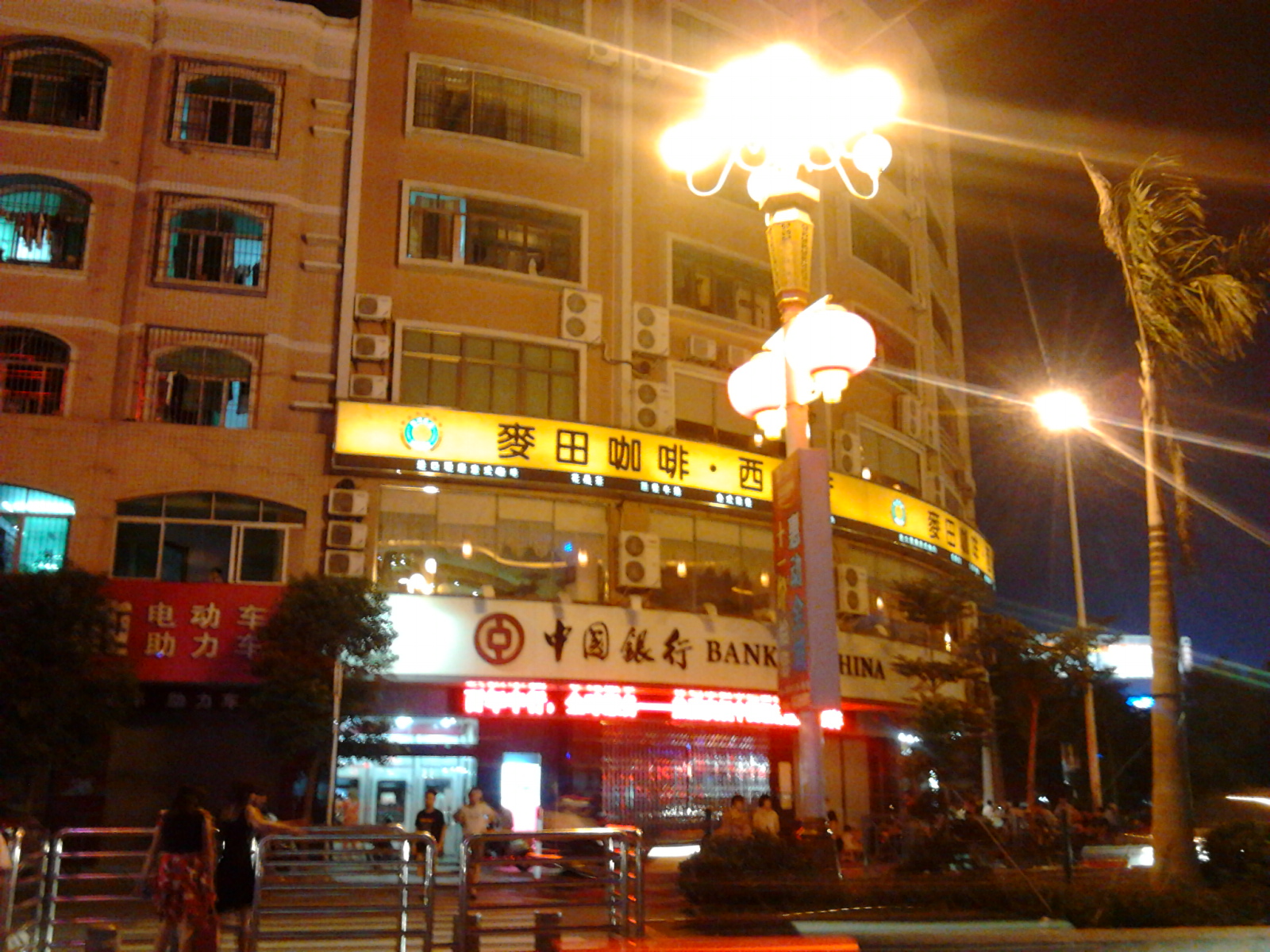
The real charm of the city
appears at night (after 7p.m.), when the neon-advertising
signs, names of buildings, hotels, etc.
light up. What’s more, there are
also highlighted trees in parks and bridges, which really makes the city more interesting.
As a beginning that’s all. About the
people, habits and other themes we will write as soon as we find the time.
(translation D&J)
……………………………………………………………………………………………….
Słowem
wstępu: kto? co? gdzie i dlaczego?
Do Yangjiang przyjechaliśmy 7go września,
pół martwi po 30 godzinach podróży, z czego połowę tego czasu spędziliśmy w
powietrzu a drugą połowę czekaliśmy. Oczywiście można się tu dostać szybciej,
ale wtedy i drożej. My wybraliśmy trasę Barcelona-Monachium-Pekin-Makao
operowaną przez Air China a potem do samego YangJiang dostaliśmy się autobusem.
Dodam, że dostaliśmy się po milionie (w rzeczywistości było ich ok. 10)
kontroli paszportowych i wypełnionych wniosków przyjazdu, przy czym za każdym
razem Pan(i) Celnik lub Wojskowa/Wojskowy bacznie przygląda się czy to na pewno
TY jesteś na zdjęciu w dokumencie. W tym miejscu wspomnę również, że jeżeli
chcecie kupić bilet/zapytać kogoś o coś to nawet na lotnisku międzynarodowym w
Pekinie nie liczcie na komunikatywny poziom znajomości angielskiego.
Dlaczego tu jesteśmy? Ponieważ bierzemy
udział w Aiesec Global Internship Programme. Jeżeli ktoś jest bardziej
zainteresowany szczegółami aplikacji itd. Profil na fcbk jest stale aktualizowany
i można tam znaleźć wszystkie potrzebne informacje) i w związku z tym nasz
planowany pobyt będzie wynosił 10 miesięcy. Już w przeciągu pierwszych 2
tygodni uzbierało się mnóstwo spostrzeżeń, które postaramy się regularnie
opisywać.
Na początku krótko o samej okolicy. Chiny
podzielone są na prowincje, które w rzeczywistości są wielkości Europejskich
państw. Łatwo się domyślić, że tak ogromny obszar jest bardzo zróżnicowany
wewnętrznie – pod względem środowiska naturalnego i klimatu, języka, kuchni a
także pewnych obyczajów a nawet i wyglądu mieszkańców. Stąd nasze zapiski i
wnioski oparte są na podstawie tego obserwacji konkretnego regionu i nie mamy
zielonego pojęcia jak jest w innych prowincjach.
Mieszkamy w południowo zachodnich Chinach, w
prowincji Guangdong, gdzie stolicą jest Guǎngzhōu
(po polsku Kanton), w małym- bo liczącym „zaledwie” prawie 3 miliony
mieszkańców- mieście YangJiang. Panuje tu subtropikalny klimat, który
charakteryzuje się gorącym pora deszczowa i chłodniejsza porą suchą. W praktyce
oznacza to tyle, że teraz mamy koniec września, 30 stopni, co kilka dni pada
bardzo ulewny deszcz a powietrze cały czas jest wilgotne. Parno i duszno.
Środowisko naturalne: palmy i ogromne
zielone rośliny (chyba jukowate?), bambusy i dużo kwiatów i przeróżnych pnącz.
Jaszczurki, ogromne ważki i ślimaki oraz
6 centymetrowe karaluchy.
Samo miasto podobno w porównaniu z innymi
chińskimi miastami jest ładne. Słynie z dobrego jedzenia (głównie owoców morza)
i produkcji noży. Jeżeli oczekujecie budynków, które my, europejczycy,
postrzegamy jako typowo chińskie (czyli takie z czerwonym dachem o
charakterystycznym kształcie, które mają nasze chińskie restauracje) to
przestrzegam, że prawie ich tu nie ma. Podobno zdarzają się w małych wioskach,
a ładnie zachowane są w Pekinie i Xi’an – Chińczycy je niszczą by na ich
miejsce postawić nowe, modernistyczne budynki, w myśl filozofii „nowe to
lepsze!”
Krajobraz stanowią wielkie szare budynki
oraz kolorowe (przeważnie czerwono-złote) hotele. Czar miasta ujawnia się po
zmroku (czyli po 19), kiedy zapalają się wszystkie neony-szyldy reklamowe,
nazwy hoteli itd. Prócz budynków podświetlone są też drzewa w parkach i mosty,
co na prawdę dodaje miastu uroku.
Tyle słowem wstępu. O ludziach, zwyczajach i
różnych różnościach opowiemy, jak tylko znajdziemy czas.
(DM)
..............................................................................................................................
Una breve presentación: quién? qué?dónde y porqué?
Llegamos a YangJiang el 7 de septiembre,
medio muertos tras 30 horas de viaje, la mitad del tiempo lo pasamos en el aire
y la otra mitad a la espera. Por supuesto se podría haber llegado mas rápido,
pero a un coste mayor. Así que nos decantamos por el itinerario siguiente:
Barcelona-Múnich-Beijing(Pekin)-Macao con la gentileza de Air China y después
un autobús que nos llevó hasta donde nos encontramos y hacemos vida, Yangjiang.
Debo añadir que tuvimos que pasar un sinfín de controles de documentación (de
hecho, alrededor de unos 10) y rellenar formularios de llegada, y cada vez el
señor o la señora agente de aduanas miraba detalladamente si eras tú el que
aparecía en la foto o no. Llegados a este punto cabe mencionar que comprar un
billete/preguntar algo a alguien, en la calle e incluso en el aeropuerto
internacional de Beijing, es mejor no contar con que ése alguien tendrá un nivel
comunicativo de inglés.
Por qué estamos aquí? Porque participamos
en el AIESEC Globlal Internship Programme -si alguien está interesado en los
detalles su perfil de facebook es constantemente actualizado, y ahí encontraréis
toda la información necesaria - y, por lo tanto, nuestra estancia tendrá una
duración de 10 meses. En la dos primeras semanas ya hemos acumulado un montón
de percepciones que iremos describiendo regularmente.
Ahora un breve resumen sobre el área: En
primer lugar, China está dividida en provincias, las cuales son de hecho, del
tamaño de países europeos. Es fácil imaginar que semejante territorio es muy
diverso, en términos medioambientales y de clima, lengua, cocina y ciertas
tradiciones e incluso la apariencia de las personas. De ahí que nuestras notas
y conclusiones estén basadas en la observación de esta región en particular y
no tenemos ni idea de cómo son en las otras provincias.
Nos encontramos en el Suroeste de China,
en la provincia de Guangdong, cuya capital es Guǎngzhōu (esp. Cantón), en una pequeña ciudad - ya
que la población es de “tan solo” 3 millones aproximadamente- llamada
YangJiang. El clima es del tipo subtropical, caracterizado por una estación de
calor y fuertes lluvias y otra seca y fria. Esto significa que estando al final
del mes de septiembre hay 30 grados y cada pocos días llueve torrencialmente, y
el aire es húmedo todo el tiempo. Hace bochorno y hay una sensación de falta de
aire. La flora consta de palmeras y gigantes plantas verdes (yucas quizás?), bamboo,
un montón de flores, asi como enredaderas. En cuanto a la fauna, hemos visto
hasta ahora lagartijas, libélulas, caracoles, y cucarachas.
La ciudad en sí misma es, supuestamente y comparada
con las otras ciudades chinas, bonita. En China es bien conocida por su buena
cocina, sobre todo el marisco, y por ser grandes productores de cuchillos. Si
esperas encontrar edificios que nosotros, europeos, consideramos como los típicos
chinos (por ej., aquellos con el tejado rojo con esa forma distintiva que
tienen nuestros restaurantes chinos) ya quedais advertidos que no hay apenas
ninguno. Aparentemente se encuentran bien conservados en pequeños pueblos de
Beijing. Fueron destruidos y sustituidos por otros, nuevos y modernos, de
acuerdo a la filosofía de “lo nuevo es mejor”.
El paisaje consiste de edificios grises y
otros más coloridos (normalmente rojo y dorado).El verdadero encanto de la
ciudad tiene lugar durante la noche (a partir de las 19h.), cuando los rótulos
luminosos, de hoteles, edificios, etc. se encienden. Aún más, hay árboles
destacados en parques y puentes, que hacen de la ciudad un lugar más
interesante.
Para comenzar esto es todo. Acerca de la
gente, sus hábitos y otros temas escribiremos tan pronto como tengamos tiempo.